Had my great friend (thanks Mary!) send me an article on how good teachers become great. I am always looking for the great activities, the best, and those are done at the expense of good things. Knowing what not to do, I believe, is as important as knowing what to do -- because there simply are not enough minutes.
I found the post great because it started talked about perfect lesson plans, bulletin boards and binders. The title said great teaching - and that is my goal - and I don't do any of that. Ugh! It was talking about all the things I skip to put time on authentic tasks that make students ready for what lays beyond my walls. But then just about when I was ready to scream - it pivoted about how students need opportunities - authentic tasks. And how much of the good teacher tasks must be skipped to be great (whew...) --- saying: "In fact, becoming a great teacher requires that much of the good teacher code be broken."
Think of all the things that can suck time -- Having perfect lessons, or the best hall passes or having all the right forms and binders prepared.... Heck those are things I often make the office ask for twice (cause a lot of stuff they ask for they just file, and most of the time - they ask once and not again). Doing TPS things just takes more time than it is worth. Uhhh...yeeahh...
Making things happen takes time but I think great teaching is letting students go (it was the number 1 thing in the article) - and that does not take as much time. But I think that is hard for us as teachers. Control can seem like a precious commodity, but in the end it is in the student's best interest to put them in control. And success is nice but a lot more can be learned in failure and revision (for us teachers too).
And the results are undeniable once you put students in control. For years I have assigned projects using ideas and software that I have not done. I think I could - but I am after end results, students can figure out details to create things (assigning a 3D house in Google Sketch Up is the largest project - I can barely draw a prism in Sketch Up).
I plan to focus my upcoming reflections on how important minutes are in my classroom. Not just for me and my time, but more importantly, my students time.
Showing posts with label student. Show all posts
Showing posts with label student. Show all posts
Sunday, June 12, 2016

Saturday, October 3, 2015
Checking for skills versus procedures
I assess often. I have many reasons why, but that is for another time. To help grade efficiency I have rules about writing on one side of paper and leaving space for problems. I joke about helping an old man out with my students.
But what do we do when a student does not do it? Should we take points off for not following directions or for being insubordinate?
I don't - I grade math and work with the students for the next assessment. In the real world you often get chances to correct "format" things (and lets not kid ourselves school is not real world). And I don't agree that this type of instructions is about responsibility.
I write messages - a :( with a drip of water for a tear on a paper, or a message from a character - like a superhero or singer or a even just from a tree, like this:

While it is tempting to punish, my job is to teach.
But what do we do when a student does not do it? Should we take points off for not following directions or for being insubordinate?
I don't - I grade math and work with the students for the next assessment. In the real world you often get chances to correct "format" things (and lets not kid ourselves school is not real world). And I don't agree that this type of instructions is about responsibility.
I write messages - a :( with a drip of water for a tear on a paper, or a message from a character - like a superhero or singer or a even just from a tree, like this:
While it is tempting to punish, my job is to teach.
Monday, November 11, 2013
Projects - Hard Work But Good Returns -- Solar Dedication!
Projects take work. But hard work leads to good days! Today was a good day - we had our solar dedication today. We spoke about the project, about student lead projects and how when given time students produce!
We had a small crowd but was visited by the Wisconsin State Journal - watch for an Article about the Juda Physics Class on some Tuesday (soon)!
Here are some pictures:


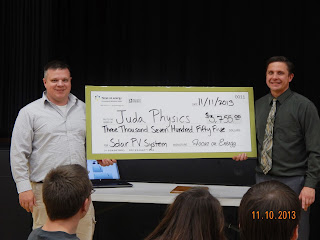


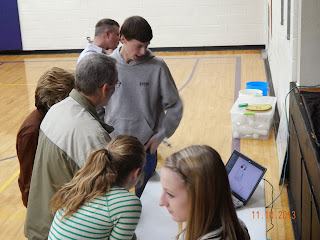
We had a small crowd but was visited by the Wisconsin State Journal - watch for an Article about the Juda Physics Class on some Tuesday (soon)!
Here are some pictures:


Thursday, July 18, 2013
If a student does not want to be taught, can we teach him/her successfully?
Found this poll question in a Linkedin group that I am a member of:
My answer to the poll was yes and I comment the following:
If a student does not want to be taught, can we teach him/her successfully?
My answer to the poll was yes and I comment the following:
"Absolutely YES,
usually our problem with students "who do not want to be taught" is that
they really just don't want to fit into our system. Our system of
education is rigid and really inflexible. It may take different ways and
way more time but it is always possible. Whether it can be done
practically is another story, but yes we can."
The thing I started reflecting on beyond why ask the question at all is what was the author visualizing or wanting to know. Obviously if someone dedicated themselves to not doing something they typically succeed. But who knows a properly cared for 6 year old who won't try somewhat for a teacher?
I think it is the previous sentence most people taking the poll did not picture. I think most people picture an older student not doing work, refusing, being a classroom management issue. Now the question - what happened from when they were six? Why won't they try?
Because they have been there, done that. They have been placed in a system that sorts and throws away. Where staff - even the ones who believe they should reach all students, routinely lose some. Because our system does not guide and nuture the student who does not fit or really struggles but outcasts and ostracizes them.
And if you have tried in the past and have had no success, feel no teacher believed in you or took the time to go outside the system, then why try now (it makes complete sense from an emotional perspective). They believe school does not work for them the way it was designed (and their belief is what is most important for their ability to learn). So once you get to that point as a teacher you need to start from scratch and found a way (ton of work, very slow return!).
Because our job is not opportunity to learn (like college), it is to prepared them for life -- and not getting the education you need to succeed should not be an option.
And when the student refuses to learn from me, and it happens - it is a failure on me.
I think it is the previous sentence most people taking the poll did not picture. I think most people picture an older student not doing work, refusing, being a classroom management issue. Now the question - what happened from when they were six? Why won't they try?
Because they have been there, done that. They have been placed in a system that sorts and throws away. Where staff - even the ones who believe they should reach all students, routinely lose some. Because our system does not guide and nuture the student who does not fit or really struggles but outcasts and ostracizes them.
And if you have tried in the past and have had no success, feel no teacher believed in you or took the time to go outside the system, then why try now (it makes complete sense from an emotional perspective). They believe school does not work for them the way it was designed (and their belief is what is most important for their ability to learn). So once you get to that point as a teacher you need to start from scratch and found a way (ton of work, very slow return!).
Because our job is not opportunity to learn (like college), it is to prepared them for life -- and not getting the education you need to succeed should not be an option.
And when the student refuses to learn from me, and it happens - it is a failure on me.
Wednesday, July 3, 2013
Time outside class - Figuring how to Flip
So as I reflect on how we are going to do homework in the coming school year, It's 2013 shouldn't HS HW look different, I am really trying to figure out how to use a flipped classroom to help deliver content. I know there is value in doing practice and problem solving during class when I can help guide the students. I also know a lot of the low level practice can be done outside of the class. But how much is enough? What I mean is how much time besides the 220 in-class minutes do I need per week?
In the past I have asked for 15-20 minutes of outside work 5 days per week, for projects, homework, etc. - though students tend to procrastinate the projects into 2-3 hour sprints. And it should be noted that I had already taken daily practice to 4-8 problems that are complete review for practice (I don't assign new content for homework). So my thought going forward is to keep the 100 minutes per week of outside time (with study halls that is not too much), somewhat tough to pick a number because everyone works at different speeds, but it is a target.
That would allow me to assign about 20-30 minutes of "online" practice per week, 15 minutes of pencil/paper homework per week, 25-40 minutes of project work per week leaving 15-40 minutes for flipped instruction. That would be about 2-3 videos per week (seems like a lot). My goal would be 1 video per week, perhaps 2.
The problem is how do you know whether a student watched the video, it would be awfully hard to do practice in class without an idea of the content (students will try to though - asking to be taught the video info in class). How do you know they watched? Reflections (google docs)? Notes? A worked sample problem? And what do you do with the students who don't watch the videos, is it the same problem as homework? Remember most students are minimalists, at 16 who cares if you understand, they are just trying to get it done (at least that was how I was).
Currently I make students stay after school to do the work on the same day (see HW FAQ), I treat assigned work like deadline work in the world, and I suppose I could do the same with flipped videos but I still need something to check (a problem, note sheet, reflection, a quiz). My temptation is to do notes for upper level courses and perhaps a google doc reflection in the trilogy courses (Alg 1, Geom, Alg 2). I plan to start making some Physics videos soon -- that would be a high level course in my school. So I would expect to see notes (because the course is open note for all quizzes, tests and exams). In the trilogy courses I think I will start with the google doc reflection (thanks to Brian Steffen).
Either way the commitment is made -- math is gonna be different.
In the past I have asked for 15-20 minutes of outside work 5 days per week, for projects, homework, etc. - though students tend to procrastinate the projects into 2-3 hour sprints. And it should be noted that I had already taken daily practice to 4-8 problems that are complete review for practice (I don't assign new content for homework). So my thought going forward is to keep the 100 minutes per week of outside time (with study halls that is not too much), somewhat tough to pick a number because everyone works at different speeds, but it is a target.
That would allow me to assign about 20-30 minutes of "online" practice per week, 15 minutes of pencil/paper homework per week, 25-40 minutes of project work per week leaving 15-40 minutes for flipped instruction. That would be about 2-3 videos per week (seems like a lot). My goal would be 1 video per week, perhaps 2.
The problem is how do you know whether a student watched the video, it would be awfully hard to do practice in class without an idea of the content (students will try to though - asking to be taught the video info in class). How do you know they watched? Reflections (google docs)? Notes? A worked sample problem? And what do you do with the students who don't watch the videos, is it the same problem as homework? Remember most students are minimalists, at 16 who cares if you understand, they are just trying to get it done (at least that was how I was).
Currently I make students stay after school to do the work on the same day (see HW FAQ), I treat assigned work like deadline work in the world, and I suppose I could do the same with flipped videos but I still need something to check (a problem, note sheet, reflection, a quiz). My temptation is to do notes for upper level courses and perhaps a google doc reflection in the trilogy courses (Alg 1, Geom, Alg 2). I plan to start making some Physics videos soon -- that would be a high level course in my school. So I would expect to see notes (because the course is open note for all quizzes, tests and exams). In the trilogy courses I think I will start with the google doc reflection (thanks to Brian Steffen).
Either way the commitment is made -- math is gonna be different.
Sunday, February 24, 2013
Is it the job of technical schools, 2 years colleges and state schools to help students through math?
I recently read an article that says a post secondary degree is becoming the new HS diploma for getting a job (degree deflation). So as good jobs disappear for people with only HS degrees, we see everyone talk about worker retraining -- get them back to school to get the skills for the jobs of today. And I think that is great, and I agree.
But what responsibility does the technical school/college have to getting students through math. We often talk about secondary schools providing opportunity, a student must choose to work and do well. But with most remedial math students (and especially non-traditional students) it is not a choice, they have not done well with math at the HS level and instead of realizing that, our secondary institutions demand more math, faster, at a higher level of performance than HS. Now I agree high schools must do better but I don't agree with institutions that decide to 'help' but really are entering for profit or pseudo-profit.
What I mean is once you tell prospective students that you can lead them to better training thus to better jobs you have a commitment to that student. That student is paying for a service. When you then place students into remedial math courses that as an institution you know only have a 40-50% pass rate you are doing a disservice. Especially with non-traditional students. Only in our secondary education system can you look at a 50% pass rate and blame the students.
I am not saying we teach less, but once you run into a wall a few times, shouldn't you look for a door? Should we look at how we are teaching, how do we expect students who have never mastered numeracy to quickly do that in a few weeks, so we can do lines, expressions and quadratics? I believe these are skills that a student should master but is the current system correctly doing that; with so many non-traditional students that have not used math skills for so long that they have lost them repeatedly taking remedial math I think the answer is no. Yet tech schools and colleges advertise themselves as centers of opportunity, get your loan, come on in, we will help.... And sure they offer tutoring, but that is within the context of the existing secondary math curriculum, if you can't keep up, don't worry the institution will still cash your check.
Only in education could you get away with this, blaming the customers (actually failing customers who try). They have their expectation completely set by their K-12 experience. Except in HS they somehow got through. I know many non traditional students studying tens of hours per week in their quest to become non-STEM people. They face their math fears dead on, as the course sprints forward. The courses demanding that the skill of distribution learned last week, be mastered to the point to use with equations this week and next week lines.
In 6-12 grade math those subjects and their expected mastery are spread out over years versus weeks. Yet we teach math the same way at tech schools and colleges as was done in 6-12 grade where the remedial student failed to get mastery but now we expect different results. Really? I know a 12 year old more easily learns than a 42 year old (I am reminded about that every day my son and I try to remember a new skill).
Our society needs educated people to maintain our leadership in the world. We need to be constantly educating our people. But we need an educational system that works! Only in education would we say we have a 50% failure rate and believe the answer is more of the same, more courses, more instructors, more repeating! And when the non-traditional student fights through their 2 remedial courses and 1 course for credit math (usually thinking D for Degree), are they better math students? Will they apply those skills in the world? Or did they simply memorize enough to get through..... What is the purpose?
While some students do just need remedial math as it sits (looks like about 50%). The rest need something different. The courses need to meet more, cover less material and push them to success. I realize I am adding a course, hours and staff; it would take 3 remedial courses versus 2, because the same material must be learned. Courses need to meet 6 hours per week versus 3 hours. Less lecture, more guided learning, set lab hours with tutors at a 1 to 8 ratio, we must help students to understand the math. It is a radical suggestion, but we have a horrific problem, 50% failure.
Yet tech schools and colleges expand, under the disguise of providing opportunity, encouraging students to come back and learn today's skills, they'll help.... Right now they just cash the check....
But what responsibility does the technical school/college have to getting students through math. We often talk about secondary schools providing opportunity, a student must choose to work and do well. But with most remedial math students (and especially non-traditional students) it is not a choice, they have not done well with math at the HS level and instead of realizing that, our secondary institutions demand more math, faster, at a higher level of performance than HS. Now I agree high schools must do better but I don't agree with institutions that decide to 'help' but really are entering for profit or pseudo-profit.
What I mean is once you tell prospective students that you can lead them to better training thus to better jobs you have a commitment to that student. That student is paying for a service. When you then place students into remedial math courses that as an institution you know only have a 40-50% pass rate you are doing a disservice. Especially with non-traditional students. Only in our secondary education system can you look at a 50% pass rate and blame the students.
I am not saying we teach less, but once you run into a wall a few times, shouldn't you look for a door? Should we look at how we are teaching, how do we expect students who have never mastered numeracy to quickly do that in a few weeks, so we can do lines, expressions and quadratics? I believe these are skills that a student should master but is the current system correctly doing that; with so many non-traditional students that have not used math skills for so long that they have lost them repeatedly taking remedial math I think the answer is no. Yet tech schools and colleges advertise themselves as centers of opportunity, get your loan, come on in, we will help.... And sure they offer tutoring, but that is within the context of the existing secondary math curriculum, if you can't keep up, don't worry the institution will still cash your check.
Only in education could you get away with this, blaming the customers (actually failing customers who try). They have their expectation completely set by their K-12 experience. Except in HS they somehow got through. I know many non traditional students studying tens of hours per week in their quest to become non-STEM people. They face their math fears dead on, as the course sprints forward. The courses demanding that the skill of distribution learned last week, be mastered to the point to use with equations this week and next week lines.
In 6-12 grade math those subjects and their expected mastery are spread out over years versus weeks. Yet we teach math the same way at tech schools and colleges as was done in 6-12 grade where the remedial student failed to get mastery but now we expect different results. Really? I know a 12 year old more easily learns than a 42 year old (I am reminded about that every day my son and I try to remember a new skill).
Our society needs educated people to maintain our leadership in the world. We need to be constantly educating our people. But we need an educational system that works! Only in education would we say we have a 50% failure rate and believe the answer is more of the same, more courses, more instructors, more repeating! And when the non-traditional student fights through their 2 remedial courses and 1 course for credit math (usually thinking D for Degree), are they better math students? Will they apply those skills in the world? Or did they simply memorize enough to get through..... What is the purpose?
While some students do just need remedial math as it sits (looks like about 50%). The rest need something different. The courses need to meet more, cover less material and push them to success. I realize I am adding a course, hours and staff; it would take 3 remedial courses versus 2, because the same material must be learned. Courses need to meet 6 hours per week versus 3 hours. Less lecture, more guided learning, set lab hours with tutors at a 1 to 8 ratio, we must help students to understand the math. It is a radical suggestion, but we have a horrific problem, 50% failure.
Yet tech schools and colleges expand, under the disguise of providing opportunity, encouraging students to come back and learn today's skills, they'll help.... Right now they just cash the check....
Subscribe to:
Posts (Atom)