Forward Together just put together a little PR video about the grant that allowed Juda to install Phase 2 of their solar array (all project management done by students). The applicant has to be a teacher on the grant so I was too much of a main character, when the students should have been, but it came out great (outside of how old I look).
Again - every school, every student should experience this during their K-12 schooling -- it can be done. It is problem solving, it is real world. It is just selecting great projects over good curriculum.
Showing posts with label solar. Show all posts
Showing posts with label solar. Show all posts
Friday, December 19, 2014

Wednesday, July 30, 2014
Solar - Big Business Tries To Bite Back
The front page article for Sunday's Wisconsin State Journal was Wisconsin utility companies take aim against solar power. The article reported on two Wisconsin electric suppliers requesting major changes in how they charge changing the economics of solar.
The major electric suppliers rate proposal is an all out war on solar by changing the structure on how power is billed. By moving away from kilowatt per hour charge with a reasonable connection fee, charging mainly on usage, to a large grid connection charge with negligible kW/hr charges the electric suppliers want to change how power will be created and consumed.
The proposal wants to move away from kilowatt per hour charge with a small connection fee (charging mainly on usage) to a large grid connection charge (with negligible kW/hr charges). They actually proposed lowering kw/hr charges from 15 cents to 4.5 cents but moving connection charges from roughly $10 to nearly $50!
Low kW/hr charges do not motivate people to conserve but to use. Saving some does not equal much money and thus people will be less inclined to conserve.
That does not help move our dependance from fossil fuels but makes us more of addict.
This proposal is not about the people's or the world's good but a simple attempt to shut down competition - solar competition. It is simply a proposal to guarantee coal and natural gas power plants remain the electricity leaders -- it is hiding the cost of power in a connection fee versus the usage.
Most damaging - solar project’s pay back disappears. This is not good for Wisconsin, the USA or the world.
I hope the board fights this proposal. We need to have a system that charges by the kW hour and rewards conservation and innovation -- not a move that protects profits and status quo.
Read more: http://host.madison.com/business/wisconsin-utility-companies-take-aim-against-solar-power/article_cd1fb31a-c1ad-56a4-a71b-375830d5b6e1.html#ixzz38gabJtmi
The major electric suppliers rate proposal is an all out war on solar by changing the structure on how power is billed. By moving away from kilowatt per hour charge with a reasonable connection fee, charging mainly on usage, to a large grid connection charge with negligible kW/hr charges the electric suppliers want to change how power will be created and consumed.
The proposal wants to move away from kilowatt per hour charge with a small connection fee (charging mainly on usage) to a large grid connection charge (with negligible kW/hr charges). They actually proposed lowering kw/hr charges from 15 cents to 4.5 cents but moving connection charges from roughly $10 to nearly $50!
Low kW/hr charges do not motivate people to conserve but to use. Saving some does not equal much money and thus people will be less inclined to conserve.
That does not help move our dependance from fossil fuels but makes us more of addict.
This proposal is not about the people's or the world's good but a simple attempt to shut down competition - solar competition. It is simply a proposal to guarantee coal and natural gas power plants remain the electricity leaders -- it is hiding the cost of power in a connection fee versus the usage.
Most damaging - solar project’s pay back disappears. This is not good for Wisconsin, the USA or the world.
I hope the board fights this proposal. We need to have a system that charges by the kW hour and rewards conservation and innovation -- not a move that protects profits and status quo.
Monday, June 16, 2014
Teaching for Sustainability through Green Initiatives
Note: This draft was submitted to Community Works Journal --- See edited story here!
The job of educators is to prepare students for the world, so they can have a real impact. Yet we rarely practice those skills in high school. The true passion, problem solving and perseverance are often vacant from the assignments we do with our young adults in high school.
But it does not have to be that way! Project based learning offers a variety of ways for students to have a true impact in their community and their world. That impact is often not constrained by the students but by educators and administration. What happens when student are posed the assignment - complete a project that helps the school and community AND that project needs to have a true global impact?
Amazing things happen.
The assignment started in the fall of 2011 with my thought that my Physics students needed more exposure to real world problem solving. Problems where you must persevere, where there is no correct right answer, but the thought of what it should be and how to assess what was accomplished seems daunting – until you tell them “Select a project that will help the school/community and the world and make it happen. I don't want a report or essays or papers, I want steel and concrete – I want tangible results.”
And then I sat back and watched the students struggle, some sat around waiting for orders. But I kept repeating to come up with a plan – it quickly led to true brainstorming and the idea that we could reduce Juda's carbon footprint thus reducing our energy cost! Daunting project, you bet; time consuming in class, sure; but the learning was amazing.
There are many avenues, many ideas, and many methods to making that goal. So the students made teams and defined deliverables (I had some input there – if you work you deliver). They did research. They contact vendors, suppliers, talked with staff, thought, reflected, thought of ideas, checked their ideas – failed – and tried again. But they were learning that a dead-end was simply a step to the solution, they were not guided by a predetermined lesson plan. They were working only with the constraints of a real world project – payback, ROI and need.
And all of that is more important than the results, but results are what were assigned – or should we say demand; demanded by the students – because it becomes their goal and project. All of sudden you don't need to make assignments – you simply need weekly update meetings. You don't have to hold students accountable their peers do – because it is their project.
Results happen because students are given the latitude to accomplish their goal!
At Juda, students chose green energy as the method to meet the goal and divided into solar and wind research teams. Researching ways to install either a turbine or panels, doing the bids, the Return-On-Investment (ROI), the financing – calculating how, why, what and where.
So where did my first team of students get to in 9 months, September 2011 to May 2012 – from inception of their idea to the end of the school year is not very long. The students had done all the research, competitively bid solar and wind, selected a preferred solar supplier, obtained permits, discuss the project with administration and our school board, worked on achieving ROI – and that is where the first group left the project. Now often it would end there with a bid, but the key to PBL is to continue the previous before starting the new! So this became a legacy project -- because that is what the world does! It reassigns projects - moves around team members. This was just a pause in the project versus its end.
One problem initially with my rural school is that Physics is offered every other year. So a team of students who had taken Physics the previous school year watched on grants and financing outside of an 'assigned class' during the 2012-2013 school year.
Then Wisconsin Focus-On-Energy money became available in the summer of 2013, and this was the last piece of the puzzle for the first project. We had worked on financing, discussed finding business partners and this Focus on Energy grant with other local business support allowed the project to proceed. It then became the Physics class of 2013 job to do the install, and starting in September 2013 Juda was generating over 5 kW of electricity for our school . Meeting the original goal of positive community impact along with a global impact – but that was not enough. Because as that assignment was completed, it was now 2013's Physics class turn - you complete the prior project, now start yours!
That is how project based learning comes to be a cultural change, the learning becomes perpetual. The students not only want to be part of the team on the previous project but literally demand their own project.
The 2013-2014 Physics class's project is to make 10% of the school's total power be generated greenly on school property, really ambitious when the 5 kW solar system is only 4% of the schools power. They have already installed another 12 panels increasing the systems capacity by 50% to 7.5 kW. They have started conservation projects, such as lighting and heating, ventilation and air conditioning (HVAC).
And now this project is being moved onto to the next team in the next school year. Plenty has been accomplished – nearly 7% of the school’s power is green now. And I feel confident that the next class will get to 10%. But that was not enough for the previous class they also want to roll out the PBL Green Initiative model to other schools – every school should have students working on a 5 kW green energy system – even if you already have a solar array or a wind turbine! This story is my part of their project.
We want you to take on a green initiative with you and your students. We are offering ourselves as guides, myself and my students - take the plunge. We want contact with you, email, call, snail-mail, even by carrier pigeon. Let the chaos ensue – let the real learning occur!
Tap the resources in your school that is before you, make your students your workers - and watch them practice and acquire the skills the world wants from schools – passion persistent problem solvers!
It takes a certain level of courage as educator – you must be willing to pick great projects over good material. You need the belief that covering an allotted number of chapters does not create problem solvers. Problem solvers are created through real problems and practice (and textbooks & e-books rarely have problems, they're filled with exercises).
And as the students reflect on their accomplishments, this project is truly one of the most memorable, permanent things which they have done. It shows them what persistence, research and resilience can do.
So when you think about how and what you teach, know this is one of the things that I consider untouchable.
HOW TO SUBMIT AN ARTICLE OR ESSAY
Submissions should be sent by email, as an attachment. Most word processing formats are acceptable. Minimal formatting is suggested. Word count maximum is generally 1,600 words. Please contact us if this is a problem. In some cases we will edit for length with the author's request. An exception to word maximum may be the inclusion of information on a resource of significance to the article.
Submissions should be sent by email, as an attachment. Most word processing formats are acceptable. Minimal formatting is suggested. Word count maximum is generally 1,600 words. Please contact us if this is a problem. In some cases we will edit for length with the author's request. An exception to word maximum may be the inclusion of information on a resource of significance to the article.
The author's name and email must be included.
Community Works Journal
PO Box 6968 l Los Angeles, CA 90602 l 909-480-3966
email: info@communityworksjournal.org
- See more at: http://www.communityworksinstitute.org/cwjonline/submitguide.html#sthash.k5jAZuub.dpufPO Box 6968 l Los Angeles, CA 90602 l 909-480-3966
email: info@communityworksjournal.org
Dr.
Cathleen Becnel Richard is an Assistant Professor at Nicholls State
University in Thibodaux, Louisiana. She earned her doctorate in 2010
from Northcentral University in E-Learning and Teaching Online. Her
research interests include academic advising, distance learning,
reflective learning, and service learning. - See more at:
http://www.communityworksinstitute.org/cwjonline/articles/aarticles-text/bayou_tchgsustain.html#sthash.uZ3CFLf1.dpuf
Sunday, April 27, 2014
Letter supporting Wisconsin Journal Article - Green Energy needs to be goal!
Last week I wrote here about an editorial in the Wisconsin State Journal which I support and expanded on. I also wrote a letter to the Journal about it. The optimist in me hopes this can be the start of something bigger for our schools and our students.
I would ask if you feel this is something Wisconsin should push for please contact your representatives, involving ourselves in the process is the only way to get action.
Letter:
I would ask if you feel this is something Wisconsin should push for please contact your representatives, involving ourselves in the process is the only way to get action.
Letter:
Wisconsin must be proactive about green energy. It's a way to reduce dependence on fossil fuels and a wise investment in our future. Wisconsin's goal should be to include our schools and students.My school has used green energy to help students learn the skills the world requires. They have researched and completed multiple solar projects. Using solar energy means a long-term reduction in cost to operate our school. Once the panels are paid for, the energy keeps coming. It is proactive and creates a powerful learning experience for students.The Wisconsin Legislature should help schools meet ambitious goals for producing their own power. Students can lead projects, find ways for their schools to do the work and reduce their costs. Students are an untapped resource -- their drive makes amazing things happen.Our Legislature should help fund schools so all districts can generate 10 percent of their power. While green energy is great, students leading and creating it is too positive an outcome not to invest in.-- Scott Anderson, math and physics instructor, Juda Public School
Monday, April 21, 2014
Wisonsin needs ambitous clean energy goal in our Schools!
The opinion section of the Wisconsin State Journal dated Sunday, April 20th was "Wisconsin needs ambitious clean energy goal." I generally agree with the theme and believe that green energy is a way for us to reduce our dependence on fossil fuels and is a wise investment in our future. I also believe Wisconsin's goal should be more than just a percentage of our energy use in the state. Our goal should include our schools and students - we need to make everyone good consumers and decision makers with respect to energy. (FYI -- I don't want to enter a comment nightmare about political views, I just want to discuss simple economics of green energy and the power of students with legislature assistance.)
The school where I teach has been using Green Energy to help my students learn the skills that the world and workplace require (project management, problem solving, analysis, justification, etc). We have avoided entering the climate change debate because people tune out, we have simply studied whether green energy makes good financial sense. They discovered that generating our own electricity at our school with securing some small grants and donations simply made sense. Using solar and wind versus carbon based products in the long term simply means a long term reduced cost to operate the school in our district. Once the panels are paid for, the energy just keeps coming, it is simply a method to pre-purchase power. It is proactive and can create powerful learning experiences for students.
The Wisconsin legislature should be pushing ways to help schools met ambitious goals for producing their own power, using students to lead the projects and find ways their schools can do the work and reduce their long term costs. Students are an untapped resource in every district - their drive can make amazing things happen (video about using Real Problems, Real Projects and Real Solutions).
Students can get the project going - can analyze if a 15 year payback, with an ROI over 5% is a "good" project - then tell the boss (the board). Each school in the state should have students working on this and presenting to their school boards. We know school buildings will not disappear over the next decade - the costs to operate a school is one of the few places where reducing the cost does not effect students!
Now I (and my class) agree that some grants are needed, the cost of solar straight up puts paybacks into the 20 plus year range. But that is where the legislature can help, channeling grants through Focus On Energy for student led projects could be a boon for our education system from the stand point of learning and reducing our school distirct's operating costs. Currently nearly all the money spent on electricity goes out of state - and yet the sun gives enough energy every hour to power the world for an entire year - so we can easily power 10% of our school's consumption!
My class has found people who want to make green energy about climate change, about the Middle East, about amount of government, etc -- some people want to make this a political discussion and that leads to all kinds of arguments. We stick to the idea that it is really just good sense to reduce your long term repeating costs. And energy, like everything else, gets more expensive with time. Pre-buying power can be a win for the schools, the state and its taxpayers and most importantly the students! I urge the State Journal to bring this to fore front with their editorial board and I urge our legislature to find a way to help fund schools so that all districts can generate 10% of their power. And while education funding is complicated and hard, this type of initiative is a one time funding thing and the state is in the right place to do it now. Action can lead to results.
Cause every kilowatt, every dollar counts -- waiting is giving away power and savings -- but more importantly students building and leading is too positive an outcome not to invest in immediately.
Thursday, December 5, 2013
Samsung Solve for Tomorrow Competition -- Juda Students and Teacher write contest Lesson plan and win.
So today I received an email for Samsung telling me Juda had won the State competition for their Solve for Tomorrow contest. I was very excited - winning is good, being the state winner is awesome, round 2 is making a video which is exciting (there are 50 state winners and 5 go to the "finals"), and $20,000 of Samsung products will be great. And though I did do some work on the grant, it was a combined effort with my Physics class. They brainstormed, wrote, and are the bigger part of the "win" and more importantly are the major cog in making the next step in our solar, green energy project happen.
Our project is to push hard and make Juda get 10% of its energy from green supplies (increasing another 6% beyond what the current solar array does). And more importantly showing other schools how they can do this project. Rolling out our documents, our lessons, and using our video to get people excited. Students can make change. It will help by showing how they can get green, reduce their school's operating costs and show how students, whether in a class or an organization, can take ownership in making their school, their community, their world a better place. Our video will support this vision!
So today I am simply over-joyed, so were my students. Tomorrow we start this year's project - with funding already there. Ahhh.
Tuesday, December 3, 2013
School Spotlight! Juda makes Wisconsin State Journal
So one of the things the Physics class did with the solar installation was to get publicity for our school and green energy. And we were really pleased to be put into the Wisconsin State Journal (1 of the 2 really major papers in the southern part of the state).
Read it here! I am feeling really good about it!
Read it here! I am feeling really good about it!
Saturday, November 16, 2013
Focus on Energy - Solar Project
Enjoyed receiving the grant money from Focus on Energy, so we (me and the Physics class) decided to video the check opening! Yup - I am that guy.
We also have completed the Power Plant page so anyone can what is happening with the panels! So that is it - project = DONE!
So just like the video said - we are done with the 24 panel install. But we have already started saving for Phase 2 - 12 more panels! So to be part contact Juda Schools and tell them you want to help! $$
Wednesday, November 13, 2013
Samsung Solve for Tomorrow Finalist! "Official" Press Release!
A big part of teaching is letting the community know what is happening - it is something I take very seriously. Whether I am writing up an article about curriculum, the math team or anything - but especially positive things. So below is the article for the Samsung Contest:
Juda selected as State Finalist in Samsung Solve for Tomorrow contest
JUDA – Juda School is pleased to announce that Scott
Anderson and his Physics class have been selected as one of the five state finalists
in Wisconsin in the Samsung Solve for
Tomorrow contest.
Juda used their Physics STEM (Science, Technology,
Engineering, Math) solar project as a basis for their contest entry, stating: At
Juda we incorporate real world projects within the curriculum; we research projects and create a variety of
solutions. This contest would allow us to chase our next big project
which is always decided through student brainstorming about our school and our
community. Our last large project is just finishing, where we are
researching ways to reduce Juda school's carbon footprint. The students
investigated many projects and now 2 years after the initial assignment we are
installing a 24-panel array. These
are STEM projects with real-world results.
Since 2004, Samsung’s education programs have contributed more
than $13 million in technology to more than 500 public schools in the U.S. In
2010, Samsung unveiled a new contest initiative called Solve for Tomorrow to
foster more enthusiasm in STEM education. Together with industry and other
partners, the Solve for Tomorrow contest uses technology as a motivator to
raise awareness and interest in STEM learning among teachers and students.
Samsung stated that “We were amazed by the quality of
entries that we received this year and applaud your dedication to inspiring
your students, improving your local communities and fostering STEM education in
your school.” Juda was selected out
of the more than 2,300 applications to be one of the five best in Wisconsin. Just
for being a finalist Juda is receiving two Samsung Galaxy Tablets to aid in their
classroom instruction!
Juda is now competing against four other schools to
be the state winner. Should Juda win, they would receive a video
technology kit and a technology package valued at $20,000.
Mr Anderson and his Physics class are now completing
the next phase of the contest – creating a “lesson plan” that will serve as the outline
for their project and accompanying video.
Monday, November 11, 2013
Projects - Hard Work But Good Returns -- Solar Dedication!
Projects take work. But hard work leads to good days! Today was a good day - we had our solar dedication today. We spoke about the project, about student lead projects and how when given time students produce!
We had a small crowd but was visited by the Wisconsin State Journal - watch for an Article about the Juda Physics Class on some Tuesday (soon)!
Here are some pictures:


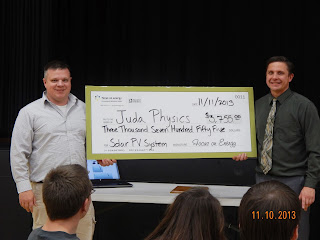


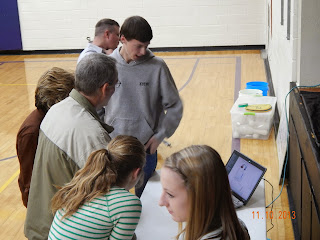
We had a small crowd but was visited by the Wisconsin State Journal - watch for an Article about the Juda Physics Class on some Tuesday (soon)!
Here are some pictures:


Friday, September 27, 2013
Turning on the Solar
Check it out! We turned on the solar today! Just over 2 years to do the project - and today we started generating about 4 kW right away on a partly sunny day! (at about 1:00 pm)
It is a pretty sweet feeling -- a student lead project that has real world positive effects. The only reason I get the glory is that all the students who started the project are at college!
PBL at work.
Monday, September 23, 2013
Green Energy - Week One of Installation
Last week our vendor, Synergy Renewable, came and did some measurements and met their new "project managers" - the 2013-14 Physics class. We are very excited, and most of the install is now done! It is really a great finish to a project that started 2 years ago with the Physics class of 2011-12 (we offer Physics every other year at my school).
With effort and tenacity big projects can happen! Take a look!


The inverter will arrive in the next day or two and then we will be powering our green school!
With effort and tenacity big projects can happen! Take a look!


The inverter will arrive in the next day or two and then we will be powering our green school!
Saturday, July 27, 2013
Green Energy - Putting Solar at Our School -- Two
So this has been an excellent week for green energy at my school. Thanks to tremendous community support we have been able to raise over 25% of the system cost (over $5000) with donations and grants. (Synergy Renewable also donated labor to help lower our overall cost.)
This brought the payback of the system into a reasonable range for our school! And this past week the board approved the purchase of Juda's first solar array. This is a commitment to the school, the community, the students and is a great support of our educational initiative to have the students do real world work. The students created a project that worked and will have be helping the district reduce costs for decades.
We are now proceeding with a 24 panel, 4.3 kW system that is warrantied for 25 years. And the day we get it install it will lower our electric bill! It will supply less than 5% of our needed power but it is a start (because the first step is hardest, the next step is always easier).
And due to the support we were able to buy a system that was slightly larger than our smallest plan! We may have even more support coming yet which would allow us to buy a slightly larger inverter thus allowing for another row or 12 panels to be added in the future.
This project showed that you just have to hold on to good ideas, cause sometimes things simply take time. The project will meet all the goals the Physics class of 2011-12 except one - which was to install the spring/summer 2012.
Yet I call the project a complete success.
Monday, July 22, 2013
Green Energy - Putting Solar at our school
Two years ago I started a project with my Physics class to research green energy for our school. It included all reports, vendor contacts, etc -- and I sat back and advised but did not teach it. I let the students find their way.
Now we are closing in on it happening! When you combine curriculum, problem solving and real world things together cool stuff happens (true PBL!)! Here is an article we did a couple of weeks ago for the local papers:
Now we are closing in on it happening! When you combine curriculum, problem solving and real world things together cool stuff happens (true PBL!)! Here is an article we did a couple of weeks ago for the local papers:
Green
Things Take Time
Two years ago the 2011-2012 Juda
Physics class embarked on the ambitious project to install a green energy
system at Juda school. It was a year-long project incorporated into
the Physics class. “Sometimes good
things take time” may be the best statement about the solar panel project at
Juda School.
The
project consisted of students’ research, reports, studies, project bids and
studies, and timelines. The students’ assessment
determined that a 24 panel roof-mounted solar array was the best fit for the
school with a price of approximately $25,000.
The students gathered bids from multiple suppliers, checked and
organized permits, completed an energy audit, updated project progress to the
school board and many other tasks. But
as teacher Scott Anderson stated “I am extremely proud of the project they
created, but like many green projects the payback was just too high to
immediately proceed without some additional funds.”
So working
with the selected solar supplier, Synergy Renewable Systems located in Oregon,
a grant was applied and received from Focus on Energy. The $3,755 grant helped clear a big hurdle
towards the additional funding the project needed; that grant along with a $2,000
labor credit from Synergy and some funding from student organizations, has now brought
the project to the brink of being a reality.
The previous and current Juda Physics
classes are now asking local businesses and community members for support to help
fulfill their vision of a green school. They
see the solar array not only as a power source but as a source of school and
community pride. “This will change how
Juda’s students think about energy and power; it will also change the culture
of our students with respect to energy.” says Scott Anderson
The
goal is to get enough funding so the project is able to proceed this summer
prior to the start of school. To see
progress of the solar project, or to help fund the project please visit www.judaschool.com.
Subscribe to:
Posts (Atom)