Showing posts with label physics. Show all posts
Showing posts with label physics. Show all posts
Tuesday, May 20, 2014
Progress on 10% Green Goal!
Big day on the 10% green project. Had students working on new lighting fixtures - test fixtures. Changing from less efficient T12 florescent lights to new LED lamps. Installed a handful today and now can "see" how they work! It was a great learning day.

Friday, February 21, 2014
How I started a big STEM project.
Here is a clip (made by one of my students) of me addressing a question on how I started our large Green Initiative STEM project.
Just in the past week a group of students worked on mapping our school for energy saving opportunities beyond lighting. Now they are working on gantt charts to define their deliverables. It really is exciting to watch them take charge.
Just in the past week a group of students worked on mapping our school for energy saving opportunities beyond lighting. Now they are working on gantt charts to define their deliverables. It really is exciting to watch them take charge.
Tuesday, December 3, 2013
School Spotlight! Juda makes Wisconsin State Journal
So one of the things the Physics class did with the solar installation was to get publicity for our school and green energy. And we were really pleased to be put into the Wisconsin State Journal (1 of the 2 really major papers in the southern part of the state).
Read it here! I am feeling really good about it!
Read it here! I am feeling really good about it!
Saturday, November 16, 2013
Focus on Energy - Solar Project
Enjoyed receiving the grant money from Focus on Energy, so we (me and the Physics class) decided to video the check opening! Yup - I am that guy.
We also have completed the Power Plant page so anyone can what is happening with the panels! So that is it - project = DONE!
So just like the video said - we are done with the 24 panel install. But we have already started saving for Phase 2 - 12 more panels! So to be part contact Juda Schools and tell them you want to help! $$
We also have completed the Power Plant page so anyone can what is happening with the panels! So that is it - project = DONE!
So just like the video said - we are done with the 24 panel install. But we have already started saving for Phase 2 - 12 more panels! So to be part contact Juda Schools and tell them you want to help! $$
Wednesday, November 13, 2013
Samsung Solve for Tomorrow Finalist! "Official" Press Release!
A big part of teaching is letting the community know what is happening - it is something I take very seriously. Whether I am writing up an article about curriculum, the math team or anything - but especially positive things. So below is the article for the Samsung Contest:
Juda selected as State Finalist in Samsung Solve for Tomorrow contest
JUDA – Juda School is pleased to announce that Scott
Anderson and his Physics class have been selected as one of the five state finalists
in Wisconsin in the Samsung Solve for
Tomorrow contest.
Juda used their Physics STEM (Science, Technology,
Engineering, Math) solar project as a basis for their contest entry, stating: At
Juda we incorporate real world projects within the curriculum; we research projects and create a variety of
solutions. This contest would allow us to chase our next big project
which is always decided through student brainstorming about our school and our
community. Our last large project is just finishing, where we are
researching ways to reduce Juda school's carbon footprint. The students
investigated many projects and now 2 years after the initial assignment we are
installing a 24-panel array. These
are STEM projects with real-world results.
Since 2004, Samsung’s education programs have contributed more
than $13 million in technology to more than 500 public schools in the U.S. In
2010, Samsung unveiled a new contest initiative called Solve for Tomorrow to
foster more enthusiasm in STEM education. Together with industry and other
partners, the Solve for Tomorrow contest uses technology as a motivator to
raise awareness and interest in STEM learning among teachers and students.
Samsung stated that “We were amazed by the quality of
entries that we received this year and applaud your dedication to inspiring
your students, improving your local communities and fostering STEM education in
your school.” Juda was selected out
of the more than 2,300 applications to be one of the five best in Wisconsin. Just
for being a finalist Juda is receiving two Samsung Galaxy Tablets to aid in their
classroom instruction!
Juda is now competing against four other schools to
be the state winner. Should Juda win, they would receive a video
technology kit and a technology package valued at $20,000.
Mr Anderson and his Physics class are now completing
the next phase of the contest – creating a “lesson plan” that will serve as the outline
for their project and accompanying video.
Monday, November 11, 2013
Projects - Hard Work But Good Returns -- Solar Dedication!
Projects take work. But hard work leads to good days! Today was a good day - we had our solar dedication today. We spoke about the project, about student lead projects and how when given time students produce!
We had a small crowd but was visited by the Wisconsin State Journal - watch for an Article about the Juda Physics Class on some Tuesday (soon)!
Here are some pictures:


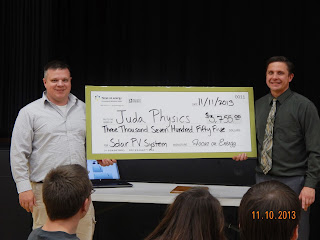


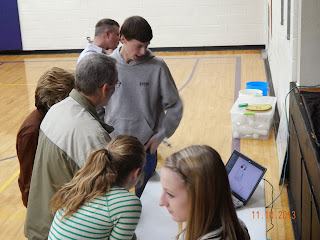
We had a small crowd but was visited by the Wisconsin State Journal - watch for an Article about the Juda Physics Class on some Tuesday (soon)!
Here are some pictures:


Friday, September 27, 2013
Turning on the Solar
Check it out! We turned on the solar today! Just over 2 years to do the project - and today we started generating about 4 kW right away on a partly sunny day! (at about 1:00 pm)
It is a pretty sweet feeling -- a student lead project that has real world positive effects. The only reason I get the glory is that all the students who started the project are at college!
PBL at work.
Wednesday, September 4, 2013
Watched first flipped videos today!
So today, on our first full day of school, I had the Algebra class and Physics class watch my flipped videos and take notes on them in class (links are in titles). And it went well, the students said they see the advantages and are excited to try it. They understood the need to take notes and worked through it with me -- best of all it took less time and the students had better engagement.
So the first step is done! I had set my lessons to watch all videos together this week, doing a few homework problems at home and reevaluate next week. But I am already thinking of flipping Friday so they can start at home. I will see how tomorrow goes then decide.
I am not sure what I expected, I did not think they would fight it but also did not think they would buy-in so easy. I am really glad FIZZ has there independent program with steps to getting you to flip (was the motivation I needed to make videos).
So now to get everyone more comfortable and move videos to homework - then the truly new part - getting better in the hour - making students higher order thinkers!
So the first step is done! I had set my lessons to watch all videos together this week, doing a few homework problems at home and reevaluate next week. But I am already thinking of flipping Friday so they can start at home. I will see how tomorrow goes then decide.
I am not sure what I expected, I did not think they would fight it but also did not think they would buy-in so easy. I am really glad FIZZ has there independent program with steps to getting you to flip (was the motivation I needed to make videos).
So now to get everyone more comfortable and move videos to homework - then the truly new part - getting better in the hour - making students higher order thinkers!
Tuesday, August 27, 2013
Flipping Algebra 1 and Physics! Where is the time and why only those courses?
So I am reflecting on why I talk so much during my typical math course! Probably cause I know so much math! Ha! Really it is based on a combination of teaching how I was taught and believing I have something really important to say! Too often I tried to talk a student to
understanding. Over the years I have lectured less and less. Now my flipped videos are about 5-7 minutes, I had lectured about 15-20 minutes last year. But the real question, what was I doing
the other 12 minutes?
I really cannot answer that question yet. Flipping makes me think about the concept harder and simplify. And hopefully flipping will make the learning process deeper.
Because if flipping works like I hope it does, students in my classroom will have better notes taken outside of class in less of their time and the class hour will be filled with problem solving and critical thinking things. I have to take it slow, I am only moving my Algebra 1 course and Physics course - and those were picked for specific reasons.
My Algebra group is always new students to me. As the only HS math teacher all other classes (Geometry, Alg 2 and so on) have had me before and are use to my style. I did not want to have the battle about "who moved my cheese." (Good book about change) Starting with a class that has never been taught by me will make it easier, they won't expect the standard lecture routine I did. (Though I was not really typical, we never graded homework or review questions from homework -- homework was recursive practice, all 'new' things happened in the hour. Still running the rest of my classes that way.)
My Physics class is upper level - Juniors and Seniors, based on large projects, labs and daily "mini-projects." Since it is a high level class I am trying to flip them too, because they are good team to discuss how the videos work and get feedback. Typically the group is self-motivated and driven, and this is science which is different than math, so again the students do not have a preconceived notation on what the class "should look like."
The biggest challenge will be setting up new hour once the videos replace homework. But the key will be too talk less and have the students do more. It is time to become a math coach.
I really cannot answer that question yet. Flipping makes me think about the concept harder and simplify. And hopefully flipping will make the learning process deeper.
Because if flipping works like I hope it does, students in my classroom will have better notes taken outside of class in less of their time and the class hour will be filled with problem solving and critical thinking things. I have to take it slow, I am only moving my Algebra 1 course and Physics course - and those were picked for specific reasons.
My Algebra group is always new students to me. As the only HS math teacher all other classes (Geometry, Alg 2 and so on) have had me before and are use to my style. I did not want to have the battle about "who moved my cheese." (Good book about change) Starting with a class that has never been taught by me will make it easier, they won't expect the standard lecture routine I did. (Though I was not really typical, we never graded homework or review questions from homework -- homework was recursive practice, all 'new' things happened in the hour. Still running the rest of my classes that way.)
My Physics class is upper level - Juniors and Seniors, based on large projects, labs and daily "mini-projects." Since it is a high level class I am trying to flip them too, because they are good team to discuss how the videos work and get feedback. Typically the group is self-motivated and driven, and this is science which is different than math, so again the students do not have a preconceived notation on what the class "should look like."
The biggest challenge will be setting up new hour once the videos replace homework. But the key will be too talk less and have the students do more. It is time to become a math coach.
Monday, July 22, 2013
Green Energy - Putting Solar at our school
Two years ago I started a project with my Physics class to research green energy for our school. It included all reports, vendor contacts, etc -- and I sat back and advised but did not teach it. I let the students find their way.
Now we are closing in on it happening! When you combine curriculum, problem solving and real world things together cool stuff happens (true PBL!)! Here is an article we did a couple of weeks ago for the local papers:
Now we are closing in on it happening! When you combine curriculum, problem solving and real world things together cool stuff happens (true PBL!)! Here is an article we did a couple of weeks ago for the local papers:
Green
Things Take Time
Two years ago the 2011-2012 Juda
Physics class embarked on the ambitious project to install a green energy
system at Juda school. It was a year-long project incorporated into
the Physics class. “Sometimes good
things take time” may be the best statement about the solar panel project at
Juda School.
The
project consisted of students’ research, reports, studies, project bids and
studies, and timelines. The students’ assessment
determined that a 24 panel roof-mounted solar array was the best fit for the
school with a price of approximately $25,000.
The students gathered bids from multiple suppliers, checked and
organized permits, completed an energy audit, updated project progress to the
school board and many other tasks. But
as teacher Scott Anderson stated “I am extremely proud of the project they
created, but like many green projects the payback was just too high to
immediately proceed without some additional funds.”
So working
with the selected solar supplier, Synergy Renewable Systems located in Oregon,
a grant was applied and received from Focus on Energy. The $3,755 grant helped clear a big hurdle
towards the additional funding the project needed; that grant along with a $2,000
labor credit from Synergy and some funding from student organizations, has now brought
the project to the brink of being a reality.
The previous and current Juda Physics
classes are now asking local businesses and community members for support to help
fulfill their vision of a green school. They
see the solar array not only as a power source but as a source of school and
community pride. “This will change how
Juda’s students think about energy and power; it will also change the culture
of our students with respect to energy.” says Scott Anderson
The
goal is to get enough funding so the project is able to proceed this summer
prior to the start of school. To see
progress of the solar project, or to help fund the project please visit www.judaschool.com.
Wednesday, July 3, 2013
Time outside class - Figuring how to Flip
So as I reflect on how we are going to do homework in the coming school year, It's 2013 shouldn't HS HW look different, I am really trying to figure out how to use a flipped classroom to help deliver content. I know there is value in doing practice and problem solving during class when I can help guide the students. I also know a lot of the low level practice can be done outside of the class. But how much is enough? What I mean is how much time besides the 220 in-class minutes do I need per week?
In the past I have asked for 15-20 minutes of outside work 5 days per week, for projects, homework, etc. - though students tend to procrastinate the projects into 2-3 hour sprints. And it should be noted that I had already taken daily practice to 4-8 problems that are complete review for practice (I don't assign new content for homework). So my thought going forward is to keep the 100 minutes per week of outside time (with study halls that is not too much), somewhat tough to pick a number because everyone works at different speeds, but it is a target.
That would allow me to assign about 20-30 minutes of "online" practice per week, 15 minutes of pencil/paper homework per week, 25-40 minutes of project work per week leaving 15-40 minutes for flipped instruction. That would be about 2-3 videos per week (seems like a lot). My goal would be 1 video per week, perhaps 2.
The problem is how do you know whether a student watched the video, it would be awfully hard to do practice in class without an idea of the content (students will try to though - asking to be taught the video info in class). How do you know they watched? Reflections (google docs)? Notes? A worked sample problem? And what do you do with the students who don't watch the videos, is it the same problem as homework? Remember most students are minimalists, at 16 who cares if you understand, they are just trying to get it done (at least that was how I was).
Currently I make students stay after school to do the work on the same day (see HW FAQ), I treat assigned work like deadline work in the world, and I suppose I could do the same with flipped videos but I still need something to check (a problem, note sheet, reflection, a quiz). My temptation is to do notes for upper level courses and perhaps a google doc reflection in the trilogy courses (Alg 1, Geom, Alg 2). I plan to start making some Physics videos soon -- that would be a high level course in my school. So I would expect to see notes (because the course is open note for all quizzes, tests and exams). In the trilogy courses I think I will start with the google doc reflection (thanks to Brian Steffen).
Either way the commitment is made -- math is gonna be different.
In the past I have asked for 15-20 minutes of outside work 5 days per week, for projects, homework, etc. - though students tend to procrastinate the projects into 2-3 hour sprints. And it should be noted that I had already taken daily practice to 4-8 problems that are complete review for practice (I don't assign new content for homework). So my thought going forward is to keep the 100 minutes per week of outside time (with study halls that is not too much), somewhat tough to pick a number because everyone works at different speeds, but it is a target.
That would allow me to assign about 20-30 minutes of "online" practice per week, 15 minutes of pencil/paper homework per week, 25-40 minutes of project work per week leaving 15-40 minutes for flipped instruction. That would be about 2-3 videos per week (seems like a lot). My goal would be 1 video per week, perhaps 2.
The problem is how do you know whether a student watched the video, it would be awfully hard to do practice in class without an idea of the content (students will try to though - asking to be taught the video info in class). How do you know they watched? Reflections (google docs)? Notes? A worked sample problem? And what do you do with the students who don't watch the videos, is it the same problem as homework? Remember most students are minimalists, at 16 who cares if you understand, they are just trying to get it done (at least that was how I was).
Currently I make students stay after school to do the work on the same day (see HW FAQ), I treat assigned work like deadline work in the world, and I suppose I could do the same with flipped videos but I still need something to check (a problem, note sheet, reflection, a quiz). My temptation is to do notes for upper level courses and perhaps a google doc reflection in the trilogy courses (Alg 1, Geom, Alg 2). I plan to start making some Physics videos soon -- that would be a high level course in my school. So I would expect to see notes (because the course is open note for all quizzes, tests and exams). In the trilogy courses I think I will start with the google doc reflection (thanks to Brian Steffen).
Either way the commitment is made -- math is gonna be different.
Tuesday, June 11, 2013
Valuing Physics over P.E.? Wouldn't it be better to evaluate talent?
So today I read an article about different pay for different positions in a school versus the traditional every teacher makes the same pay scale, Valuing Physics over P.E. .... As a math teacher on a personal level being paid more is rarely disagreeable, and I know that I am severely underpaid by what I can make in the private sector. But the top pay in this district for Elementary and P.E. is 61K and for HS math is 82K -- that is a 30%+ premium, that is a lot. (And again realize I am the person most likely to benefit from this.). And this system still has the pitfalls of the previous system.
I again see this as education's way not to deal with individual teachers and still group employees (teachers) versus actively lead them (manage). This is an attempt to sub-divide and simplify -- it does not allow for greatness in elementary (and who knows if it deals with crappy performance in the higher paid categories?) I know there are great elementary teachers in a district of 3000+ educators that should be compensated well, I also know there are mediocre math educators who probably should not get top end pay of 61K even. The issue is how to review and reward (also how to improve & motivate but that is a whole other can of worms) -- and this system has the same deficiencies as all schools -- it rewards by job category - because adminstration cannot or does not know how to reward by performance.
I still cannot overcome how different it was in the private sector versus public education. The private sector is easier though, the end product is easily defined in the private sector -- sales, profit, number of widgets. Education is not a widget making industry - how a student is taught K-4 is the best indication of how well they will do in High School. We need to get "rock stars" into the elementary grades but that also means evaluating and rewarding the "rock stars" -- the system cannot greatly reward very good teachers. Yet this system caps what elementary makes, and still treats all teachers as simple assembly workers - where they are just interchangeable.
As person who went from engineering to HS math - I know we have a broken pay system, period. We evaluate on categories because administration refuses to evaluate and reward. We must make teaching close to the private sector, while realizing we aren't making widgets, and we must reward the "rock star" teachers wherever they are. We must evaluate talent and reward it.
('How' is something I will think about and post my ramblings later....)
I again see this as education's way not to deal with individual teachers and still group employees (teachers) versus actively lead them (manage). This is an attempt to sub-divide and simplify -- it does not allow for greatness in elementary (and who knows if it deals with crappy performance in the higher paid categories?) I know there are great elementary teachers in a district of 3000+ educators that should be compensated well, I also know there are mediocre math educators who probably should not get top end pay of 61K even. The issue is how to review and reward (also how to improve & motivate but that is a whole other can of worms) -- and this system has the same deficiencies as all schools -- it rewards by job category - because adminstration cannot or does not know how to reward by performance.
I still cannot overcome how different it was in the private sector versus public education. The private sector is easier though, the end product is easily defined in the private sector -- sales, profit, number of widgets. Education is not a widget making industry - how a student is taught K-4 is the best indication of how well they will do in High School. We need to get "rock stars" into the elementary grades but that also means evaluating and rewarding the "rock stars" -- the system cannot greatly reward very good teachers. Yet this system caps what elementary makes, and still treats all teachers as simple assembly workers - where they are just interchangeable.
As person who went from engineering to HS math - I know we have a broken pay system, period. We evaluate on categories because administration refuses to evaluate and reward. We must make teaching close to the private sector, while realizing we aren't making widgets, and we must reward the "rock star" teachers wherever they are. We must evaluate talent and reward it.
('How' is something I will think about and post my ramblings later....)
Subscribe to:
Posts (Atom)